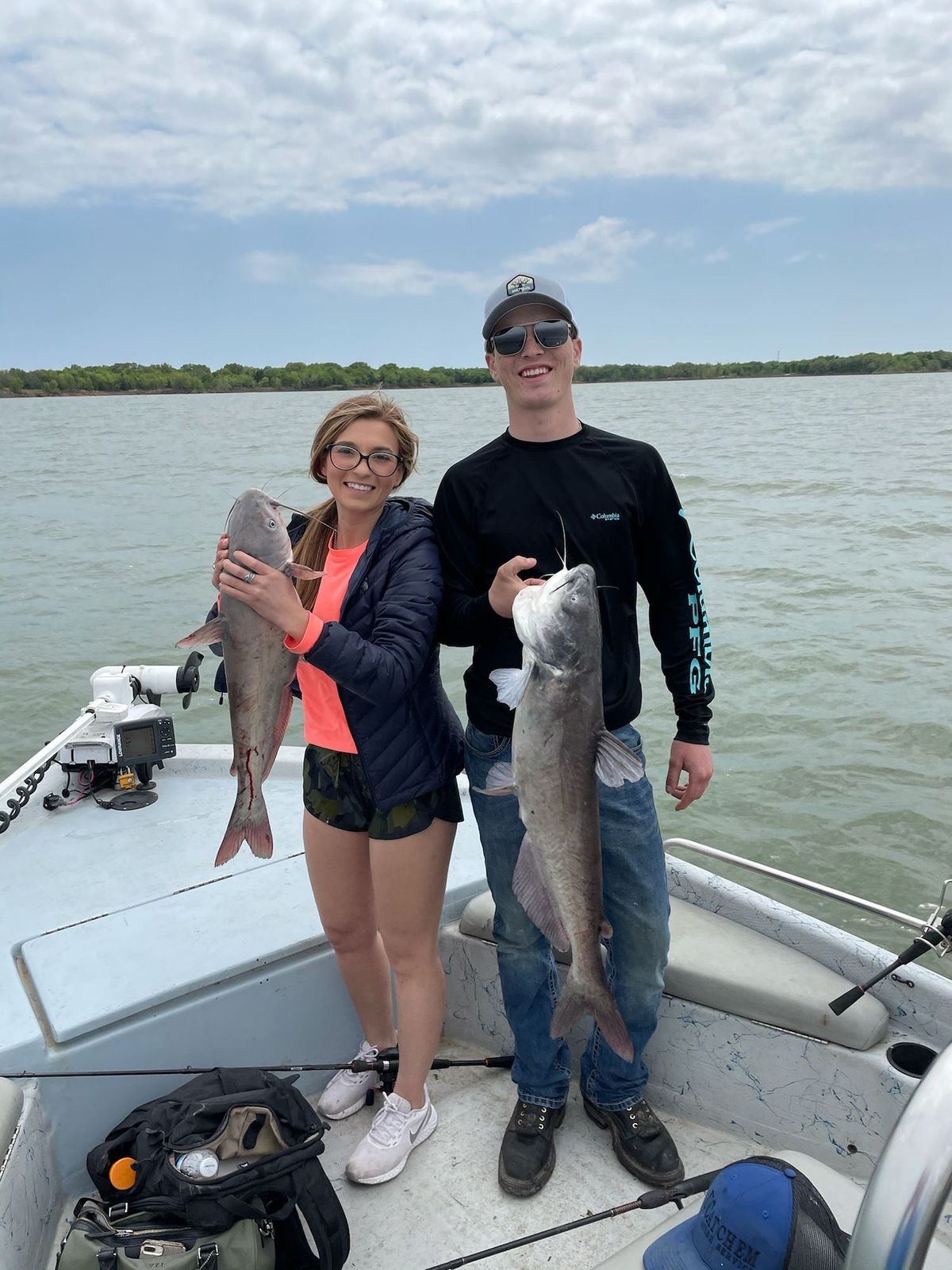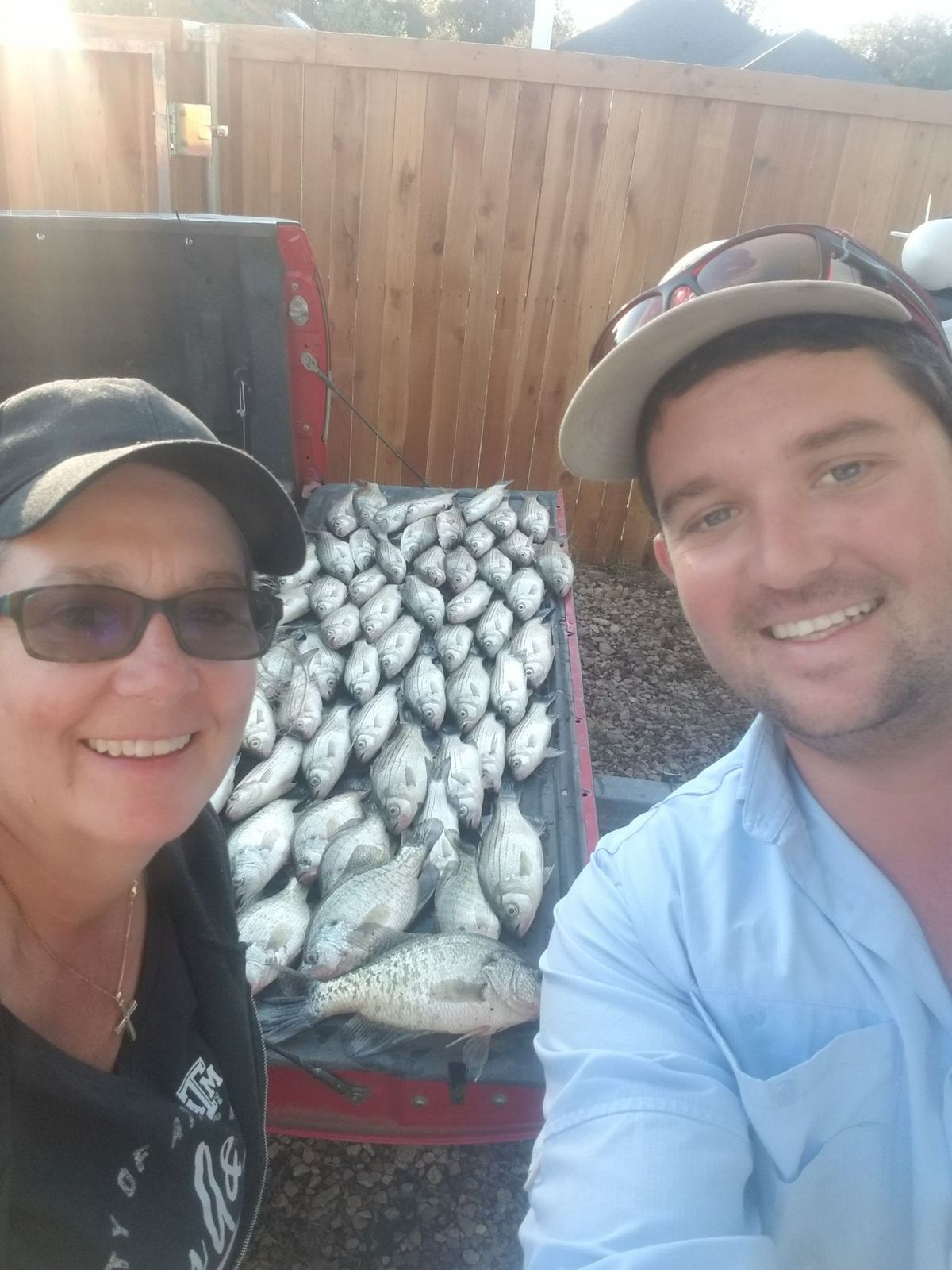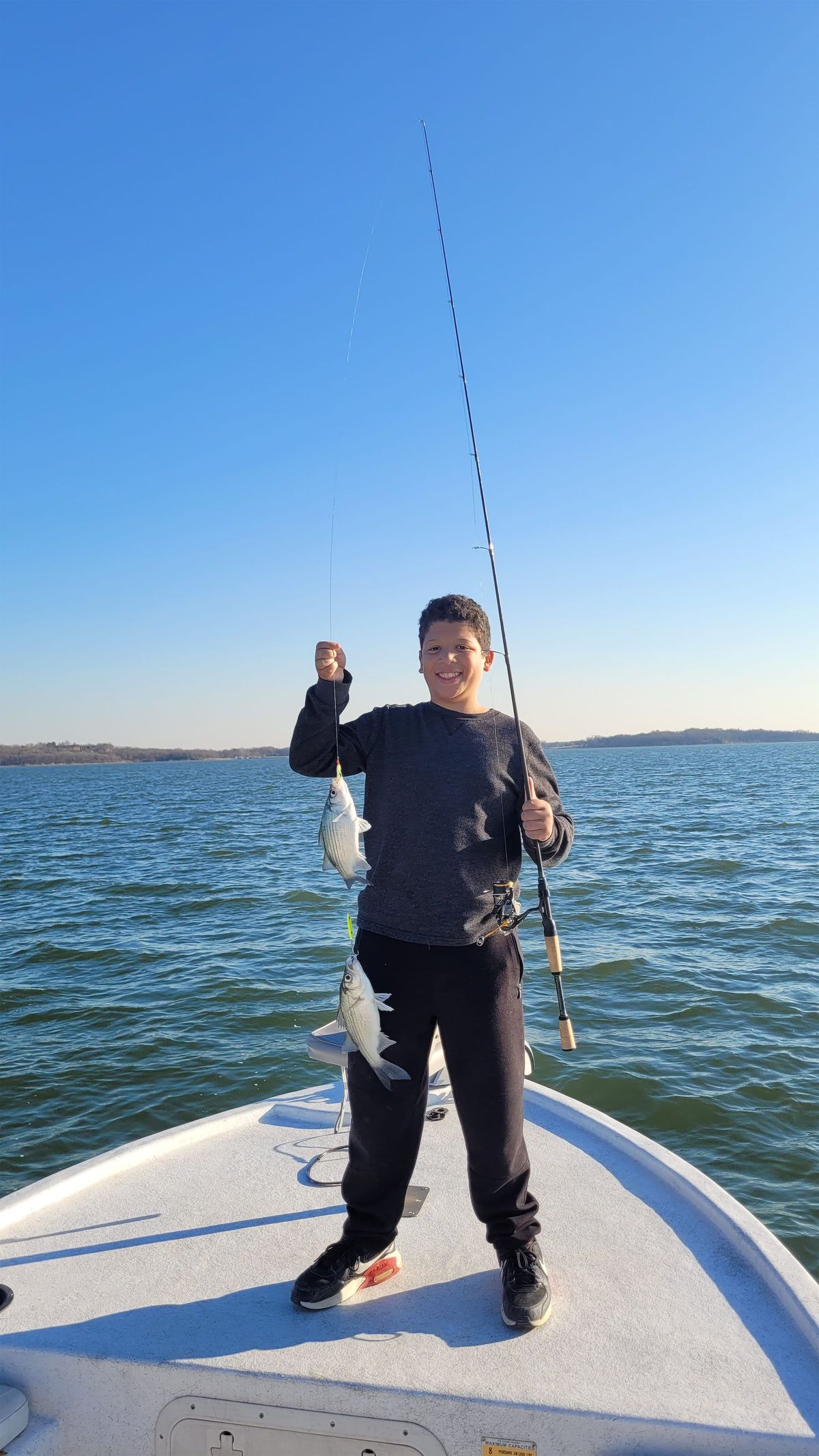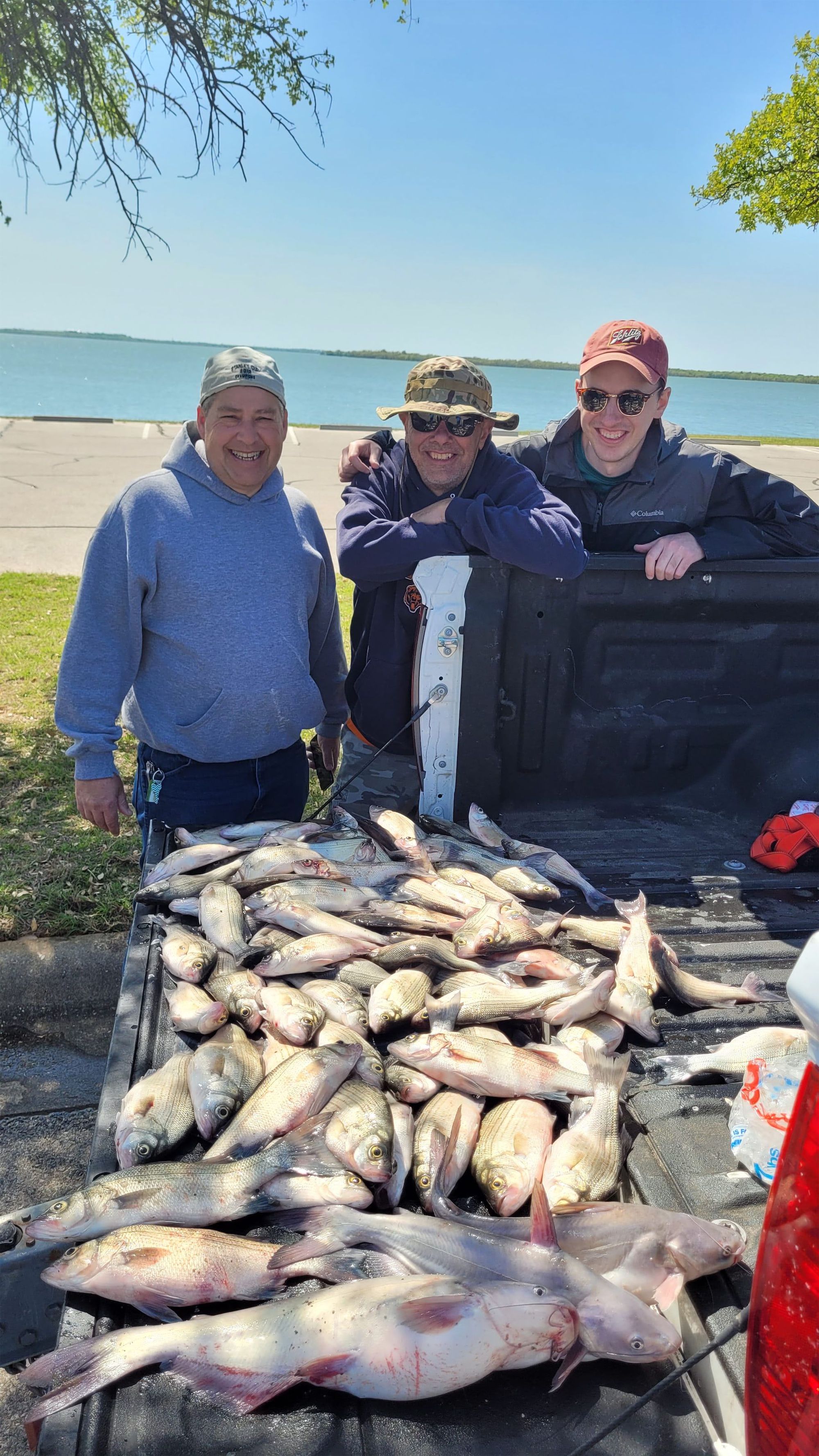
Stripers are why most people call me. I get that. The phone rings different in October than it does in July. July it's catfish. October it's stripers. And honestly, if I had to pick one fish that defines this lake, one fish that keeps people driving an hour south of Fort Worth with a cooler in the bed, it'd be striped bass.
Whitney's a striper lake. That's the reputation and it's earned. Every guide on this water leads with stripers in their marketing, but here's the thing. None of them have actually written down what they know. You'll find service pages and booking links. Maybe a YouTube video or two. But nobody's put the whole picture in one place. I'm going to do that here.
I'm not going to give you GPS coordinates. That's not how this works. But I'll tell you what stripers do on this lake, why they do it, and what I've figured out chasing them across 23,000 acres of Brazos River reservoir. If you're planning a striper trip to Whitney, this is what I'd want you to know before you get on my boat.
Why Lake Whitney Holds Striped Bass
Whitney is a big lake. 23,304 acres, built in 1951 on the Brazos River, sitting about 65 miles south of Fort Worth. Max depth runs 85 to 88 feet depending on water levels. That depth matters because stripers need cold water. They're not like largemouth that'll hang in 80-degree shallows all summer. Stripers want to be somewhere between 50 and 70 degrees, and a lake this deep gives them that option year-round.
These are landlocked stripers. Not hybrids. That's an important distinction and one that confuses people. Hybrid striped bass are a cross between a striper and a white bass, stocked in a lot of Texas lakes. Whitney has the real thing. True striped bass, same species that runs up the Atlantic coast, except these are landlocked in a freshwater reservoir. They get big. 15 to 30 pounds is a normal day. Fish over 40 pounds come out of here. The lake record is 37 pounds, caught by Dean Stovall back in 1981, and I'd bet money there's something bigger swimming around out there right now.
The Brazos River arms and tributaries give stripers what they need for their spawning run. The main lake channel gives them depth for summer. The ledges and drop-offs give them structure to hold on in winter. It all works together. That's why Whitney produces year after year.
How Stripers Behave on Lake Whitney
If you understand one thing about striped bass, understand this. They follow temperature. When the water does something, they do something. Every pattern, every seasonal shift, every time they show up somewhere new... it traces back to water temperature. Once you get that, the rest of striper fishing is showing up at the right depth with the right bait.
Stripers are pelagic. That's a fancy word for saying they cruise. They're not sitting on a brush pile like crappie or holding tight to a stump like a bass. They roam. They follow baitfish through open water. They suspend at whatever depth puts them in their comfort zone. Some days that's 15 feet. Some days it's 45.
That makes them harder to pattern than most freshwater fish. You can't just hit the same spot every trip and expect them to be there. You have to read the conditions. Water temp, time of year, where the shad are, what the thermocline is doing. That's where a fish finder becomes less of a gadget and more of a requirement.
The other thing about stripers is they're pack hunters. When you find one, you usually find a bunch. They school up and push baitfish into balls, herd them against structure or the surface, and then smash through them. If you've ever seen a striper boil on the surface, 20 or 30 fish blowing up on shad at the same time, you don't forget it. That's mostly a fall thing, and it's the most exciting fishing this lake offers.
Striper Fishing on Lake Whitney by Season
Spring Stripers (March through May)
Spring is spawn time. When water temps climb into the upper 50s and low 60s, stripers start pushing into the tributaries and river arms. They're following the current, heading upstream the way their ocean-running ancestors would. They won't successfully reproduce in a landlocked reservoir the way they do in rivers, but the instinct is still there, and it puts them in predictable places.
This is a good time to fish. The stripers are concentrated, they're moving with purpose, and they're feeding hard before and after the spawn. Water temps in the 55 to 65 degree range are the sweet spot. I fish the creek channels and river arms where current is moving. Live shad is the go-to bait. You drift it through the channels where stripers are staging and let them find it.
The spawn itself can be a little hit or miss. Some days they're locked into spawning behavior and they're not interested in eating. Other days they're aggressive. I don't totally know why one day turns on and the next doesn't. Water temp changes, barometric pressure, current flow... it all seems to matter. But the weeks leading up to the spawn and the weeks right after are reliably good fishing.
By late May the water is pushing past 70 degrees and the spring pattern breaks down. Stripers start moving toward the main lake and dropping deeper. The summer transition is on.
Summer Stripers (June through August)
Summer is the hardest season for stripers on Whitney. Not because the fish leave, they don't, but because they go deep and they spread out.
When surface temps hit the upper 70s and 80s, stripers drop to 20 feet, 30 feet, sometimes 40-plus. They're sitting below the thermocline where the water is still in their preferred range. They'll feed, but they do it in shorter windows. Early morning before the sun gets on the water. Late evening. Sometimes at night.
This is where downrigger trolling really shines. You set your baits at the depth the fish are holding, which you find with your electronics, and you troll through the areas where shad are concentrated. It's methodical fishing. You're covering water, keeping your bait in the strike zone, waiting for that rod to load up.
Jigging works too. You find a school on your fish finder, park over them, and drop a heavy spoon. 1 to 2-ounce jigging spoons, worked with a lift-and-fall cadence. Let it hit bottom, rip it up, let it flutter back down. The flutter is when they hit.
Live shad still works in summer, but you have to get it down to them. Free-lining shad in 35 feet of water takes weight and patience. I won't lie, summer striper fishing isn't for everybody. It's technical. It requires good electronics and the willingness to work for your bites. But a 25-pound striper in July hits just as hard as one in October.
Fall Stripers (September through November)
This is it. Peak striper season on Lake Whitney. If you're going to fish this lake one time for stripers, make it October.
Here's what happens. Water temps start falling from the summer highs. By late September they're back into the low 70s. By October, mid to upper 60s. By November, mid 50s. That whole range is striper paradise. They're active, aggressive, and feeding hard to put on weight for winter.
The thermocline breaks down in fall, which means stripers aren't locked into one depth band anymore. They can go wherever the bait goes. And the bait goes everywhere. Shad are schooling up, moving through the lake in big groups, and stripers follow them.
This is when you get the surface boils. Schools of stripers pushing shad to the top and feeding in a frenzy. You can see them from a quarter mile away. Birds working over the water. Baitfish spraying out of the surface. It's chaotic and it's the best kind of fishing.
Topwater is the play when you find a boil. Big walking baits, pencil poppers, anything that makes commotion on the surface. Cast past the boil and work your bait through it. When a 20-pound striper smashes a topwater plug, the hit goes up your arm.
When they're not on top, live shad and jigging spoons work at mid-depths. 15 to 25 feet is common in October. You're not having to go as deep as summer, the fish are more willing to chase, and you can cover the water column more aggressively.
November is the tail end of the fall peak. The fish are still biting but they're starting to settle into deeper patterns as the water cools further. Some of my biggest fish come in November. The crowds thin out because deer season pulls people off the water, and the stripers don't care about deer season.
Winter Stripers (December through February)
Most people hang up their rods in December. That's when striper fishing gets serious.
Winter stripers on Whitney hold deep. 30 to 50 feet on main lake ledges, channel drops, and the deeper structure near the dam. Water temps are in the 40s and low 50s. The fish are concentrated, which sounds like a good thing, and it is, if you can find them. They're not roaming as much as they do in fall. They pick a spot and sit.
Vertical jigging is the number one method. Heavy spoons, 1 to 2 ounces, dropped right on top of them. You find the school on your electronics, position the boat directly above, and work the spoon with slow lifts and drops. The bite is different in cold water. Less of a violent hit, more of a heavy pull. Like something grabbed your spoon and just decided to hold it.
Live shad drifted slow near the bottom works too. You're not covering as much water in winter. Everything slows down. The fish eat, but they eat less often and they don't chase far. Your presentation has to be right in their face.
The dam discharge area can be productive in winter. Warmer water coming through the dam draws baitfish, and stripers follow the food. It's one of the more reliable winter spots.
I actually look forward to winter fishing. Fewer boats on the water, fewer phone calls, and the fish that bite tend to be the bigger ones. There's something about sitting on a quiet lake in January with a thermos of coffee, watching your rod tip, knowing that when it moves it's going to be a good one.
Striper Fishing Techniques for Lake Whitney
Live Shad Fishing
This is the bread and butter. If I had to pick one technique that catches more stripers on Whitney than anything else, it's live shad.
Threadfin shad are the primary forage in this lake. Stripers eat them every day. So when you put a live one on a hook and drift it through an area where stripers are holding, you're giving them exactly what they're already looking for. Nothing artificial about it.
Catching shad is its own operation. I throw a cast net in the mornings before clients arrive. You want them alive and frisky. A dead shad sinks and spins. A live one swims and panics, and that panic is what triggers the bite. I keep them in an aerated bait tank on the boat. Fresh shad is the difference between a good day and a slow one.
Rigging is straightforward. Hook through the back or the nose, depending on current and how you're presenting. Light enough weight to let the shad swim naturally, heavy enough to get it down to the depth you need. Free-line them when fish are shallow. Add a split shot or a slip sinker when they're deeper.
On guided trips, I handle all of this. Catching the shad, keeping them alive, rigging them. You hold the rod and watch the line.
Trolling with Downriggers
Trolling covers water. When stripers are scattered, when you're searching for the school, trolling is how you find them. You run lures or live bait behind the boat at a controlled depth using downrigger weights, and you systematically work the areas where fish should be.
This is primarily a summer technique, when stripers are deep and suspended. You set your downrigger to the depth your electronics show fish, clip your line, and troll at a slow idle. When a striper hits, the clip releases and your rod loads up.
The key is depth control. Being 5 feet off in summer means the difference between being in the thermocline where the fish are and being above it where they aren't. Good electronics and a calibrated downrigger setup are not optional.
I don't troll as much in fall and spring because the fish are more accessible then. But in the dog days of July and August, trolling is often the most reliable way to put stripers in the boat.
Jigging
Jigging is simple and it's effective. A heavy spoon, 1 to 2 ounces, dropped vertically to the depth where fish are showing on the sonar.
The technique is a lift-and-fall. Rip the rod tip up two to three feet, then let the spoon flutter back down on a semi-slack line. The flutter is the trigger. Stripers hit on the fall almost every time. You'll feel the line go tight or heavy on the drop. Set the hook.
This works best in winter when fish are tight to structure, and in summer when they're deep and you can pin them on the fish finder. It also works in fall when you mark a school below a surface boil and want to get under the chaos.
Silver and white spoons are the standard. Chrome in clear water, white with a flash of chartreuse in stained water. Keep a few sizes. The 1-ounce gets down in moderate depth. The 2-ounce punches through current and reaches 40-plus feet without drifting wide.
Topwater
Fall mornings on Whitney when the stripers are schooling... that's topwater fishing. It's the most exciting way to catch a striper and it only really works during a narrow window of the year.
You're watching for surface activity. Diving birds, baitfish spraying, swirls and boils. When you see it, you run to it, cut the motor before you're on top of them, and cast past the school. Big walking baits, pencil poppers, large surface plugs. Work them fast and loud through the feeding zone.
It doesn't last long. A surface boil might go for five minutes, then the fish push down and the shad scatter. You wait, watch, and when it comes up again somewhere else, you chase it. Some mornings you spend more time running than casting. That's the deal.
Not every fall morning produces topwater action. Water temp, wind, cloud cover, where the shad are... it all plays into it. But when it happens, it's the best fishing Whitney has.
Where to Find Stripers on Lake Whitney
I'm not handing out spots. That's not the game. But I'll tell you what to look for, because understanding why stripers hold somewhere matters more than knowing the exact coordinates.
Main lake channel. The old Brazos River channel runs through the middle of Whitney. It creates depth changes, ledges, drop-offs. Stripers travel this channel like a highway. In winter they hold on the edges. In fall they use it as a corridor to follow baitfish. Any time you're not sure where to start, the channel is your first look.
Creek and tributary intersections. Where smaller channels dump into the main lake, you get current breaks, depth changes, and baitfish concentration. Stripers stage at these intersections, especially in spring and fall. Think of it as a funnel. Shad get squeezed into a smaller space and the stripers are waiting at the narrow end.
Dam discharge area. Below the dam, where water flows out, is one of the most consistent striper spots on the lake. Moving water brings food, oxygenated water, and slightly different temperatures. In winter especially, this draw is a magnet. Stripers stack up in the discharge zone.
Depth changes and ledges. Anywhere the bottom goes from 15 feet to 30 feet in a short horizontal distance, you have a ledge. Stripers hold along these edges because baitfish tend to travel along contour lines. The ledge gives them an ambush point. They sit in the deep side and dart up to hit shad moving along the shallow side.
Points and humps. Underwater points that stick out into the main lake and submerged humps (high spots surrounded by deeper water) concentrate baitfish and attract stripers. In fall, these are prime spots for surface boils. The structure pushes the shad up and the stripers are right behind them.
The pattern shifts seasonally. Spring, look at the river arms and tributaries. Summer, focus on the main channel and deep structure. Fall, follow the bait across points, humps, and open water. Winter, camp on the deep ledges and the dam area. The fish move. You have to move with them.
Gear and Tackle for Whitney Stripers
You don't need a tackle shop's worth of gear to fish stripers. But what you bring needs to be right.
Rods. Medium-heavy action, 7 to 7.5 feet. Enough backbone to handle a 30-pound fish pulling drag, enough tip sensitivity to feel a jigging spoon get picked up on the fall. I run baitcasting reels for most striper work. Spinning reels work fine for casting topwater and lighter presentations.
Line. 15 to 30-pound braided main line. Braid has no stretch, which means better hooksets and more sensitivity when jigging deep. You feel everything. I go heavier (25 to 30-pound) when trolling or fishing around structure where a fish might wrap me up. Lighter (15 to 20-pound) is fine for open water casting.
Leaders. 30 to 40-pound fluorocarbon leaders, about 3 to 4 feet. Fluorocarbon is nearly invisible underwater and it's abrasion resistant. Stripers don't have teeth that'll cut you off, but they have rough mouths and they fight near structure. The leader protects against rub-offs. Tie your leader to your braid with an FG knot or an Alberto knot. Learn one. It matters.
Terminal tackle. Jigging spoons in 1 to 2-ounce sizes. Topwater plugs in the 5 to 7-inch range. Bucktails with trailers. Circle hooks in 5/0 to 7/0 for live shad. A few split shots and egg sinkers. That covers 95% of situations.
On a guided trip, I provide everything. Rods, reels, tackle, bait. You don't need to bring your own unless you want to. But if you're fishing on your own, the list above is what works on this lake.
Lake Whitney Striped Bass Regulations
Standard Texas statewide regulations. Ten fish per day, 18-inch minimum length. That's combined with any other striped bass or hybrid striped bass, so keep that in mind if you're also catching hybrids in other waters.
You need a Texas fishing license if you're 17 or older. Residents pay $32 a year. Non-residents, $58 annually or you can buy a one-day for $18. Under 17 and over 65 fish for free. Buy it online at tpwd.texas.gov before you come. Takes five minutes. Cheaper than the conversation with a game warden when you don't have one.
Ten fish is a generous bag limit. On a good fall day, you could hit it. Whether you keep that many is up to you. I keep some, release some. The smaller fish, 18 to maybe 24 inches, I release. The eating-size fish are in that 5 to 10-pound range.
Eating Striped Bass from Lake Whitney
People ask me this all the time. Are stripers good to eat? Yeah. They are. Firm white meat, mild flavor, holds up well on the grill or in the oven.
A few things matter. First, bleed the fish immediately. As soon as you're keeping one, cut the gills and put it in ice water. This makes a huge difference in the taste. Striper meat that hasn't been bled has a stronger, almost metallic flavor. Bled and iced right away, it's clean.
Second, remove the bloodline. That dark red strip of meat running along the lateral line. Cut it out when you fillet. It's the source of most of the "fishy" taste people complain about. Take two minutes to remove it and the flavor difference is night and day.
Third, size matters for the table. The best eating stripers, in my opinion, are in the 5 to 10-pound range. Big enough for good fillets, small enough that the meat is still tender. A 30-pound striper is an incredible fish to catch. It's not the best fish to eat. The meat gets coarser as they get bigger. Catch the big one, take the photo, let it go. Keep a smaller one for dinner.
I bake mine at 400 degrees with butter, lemon, and garlic. About 15 to 20 minutes depending on fillet thickness. Don't overcook it. When it flakes with a fork, it's done. Simple.
Common Questions About Lake Whitney Striper Fishing
Are there actually striped bass in Lake Whitney? Yeah, and they've been here for decades. TPWD has stocked and managed the population. It's one of the better landlocked striper fisheries in Texas. This isn't a rumor or a maybe. It's a consistent fishery that produces good numbers of big fish.
What's the biggest striper caught in Lake Whitney? The lake record is 37 pounds, caught by Dean Stovall in 1981. That record has stood for over 40 years. I believe there are bigger fish in here now, but proving it means someone has to catch one and get it certified. A 40-pounder out of Whitney wouldn't surprise me at all.
When is the best time to catch stripers on Whitney? October and November are peak months. Fall is when everything comes together. The fish are aggressive, they're shallow enough to reach with multiple techniques, and the topwater bite can be incredible. But stripers are catchable year-round. Spring is the second-best window. Winter is underrated. Summer is the toughest but still doable.
Can you catch stripers from shore on Lake Whitney? You can, but it's harder. Most striper fishing on Whitney happens from a boat because you need to follow the fish and access the deeper water where they hold. Shore fishing near the dam discharge area can produce, especially in winter when stripers concentrate there. But honestly, this is a boat fishery.
How deep do stripers go in summer? 20 to 40 feet typically. Sometimes deeper. They're below the thermocline, sitting in the cooler water they prefer. You need electronics to find them and enough tackle to reach them. That's why downrigger trolling and deep jigging are the primary summer techniques.
Do I need my own boat? Not on a guided trip. I provide the boat, the electronics, the tackle, all of it. You show up with a fishing license, sunscreen, and whatever you want to eat and drink. If you're fishing on your own, yeah, you'll want a boat. A kayak could work in some situations, but you're limited on range and depth access.
What's the difference between striped bass and hybrid striped bass? Stripers are the pure species. Bigger, stronger, and they're what Whitney is known for. Hybrids are a cross between a striped bass and a white bass. They're stocked in some Texas lakes but they don't get as big and they behave differently. Whitney has true landlocked stripers. That's the draw.
Fish Stripers with a Guide Who Knows This Lake
I came to Whitney for the striper fishery, and it's lived up to it. I cut my teeth running TFA Guide Service on Lake Ray Roberts, but the stripers here are something special, and I wanted to build around them.
Every trip, I'm reading conditions before we launch. Water temperature, wind direction, recent weather patterns, what the shad are doing. I pick the technique based on what the lake is telling me that day, not a script. Some days it's live shad in the river arms. Some days it's jigging spoons over deep ledges. Some days it's running and gunning on topwater boils. The fish decide. I adjust.
I bring everything. Rods, reels, tackle, live bait, a fish finder I actually know how to read, and a hard-won read on where the fish go month by month on this lake. You bring a license, a cooler, and the ability to hold on when a striper decides it doesn't want to be in the boat.
If you want to fish Whitney for stripers, book a trip. I'll put you on them.